Health and Safety Policy for House Clearance Brockley
 Policy Statement: This Health and Safety policy sets out the principles and arrangements for safe working across our house clearance and rubbish removal operations in the service area. The company is committed to preventing injury and ill health to staff, contractors, clients, visitors and the public when conducting Brockley house clearance, waste clearance and general rubbish collection. The policy outlines responsibilities, risk management, training and monitoring procedures necessary to provide a robust and compliant approach to safety while carrying out house clearance services.
Application: This policy applies to all employees, sub-contractors and anyone engaged in domestic clearance, waste removal, skip loading and any form of property clearance activities. It covers the full range of services from small domestic household clear-outs to larger estate clearances and includes guidelines for safe lifting, hazardous materials handling, vehicle operations and site safety. The document is designed as a legal-style statement of intent and control measures for a professional rubbish company operating in the area.

Responsibilities and Management
Senior management retain overall responsibility for ensuring the house clearance company in Brockley operates safely and complies with relevant health and safety legislation. Line managers and team leaders are responsible for implementing the policy day-to-day, undertaking risk assessments and ensuring workers have access to appropriate personal protective equipment. Employees must follow safe systems of work, report hazards and participate in training and health surveillance where required.Risk Assessment and Safe Systems
Effective risk assessment is central to safe rubbish removal operations. Before any clearance, a documented assessment must identify hazards such as sharp objects, asbestos-containing materials, chemicals, biological waste and unstable structures. Control measures include exclusion zones, use of mechanical aids for heavy items, correct manual handling techniques and segregation of reusable items. The assessment process should be proportionate to the task and reviewed whenever conditions change. Personal Protective Equipment (PPE) and Hygiene: Staff must be provided with and wear suitable PPE, including gloves, high-visibility clothing, steel-toe footwear, eye protection and respiratory protection when dust or airborne contaminants are present. Hand washing facilities and sanitation provisions are mandatory to reduce cross-contamination risks. Training on correct PPE use and maintenance is part of routine induction and refresher training for house clearance operatives.
Manual Handling and Ergonomics: Proper training and the use of trolleys, lifting straps and hoists reduce the risk of musculoskeletal injuries during household clearance. All lifting tasks should be assessed and, if necessary, split into smaller lifts or assigned to mechanical assistance. Staff should be encouraged to report cumulative strain and fatigue to managers promptly to prevent chronic injury.
 Hazardous Materials and Waste Segregation: As a professional waste clearance provider, the company maintains strict procedures for dealing with hazardous items commonly encountered during property clearances, such as batteries, solvents, paints, asbestos-containing materials and sharps. These items must be segregated, stored safely and disposed of through licensed waste carriers in accordance with statutory requirements. Written protocols and a waste transfer note system support traceability and legal compliance.
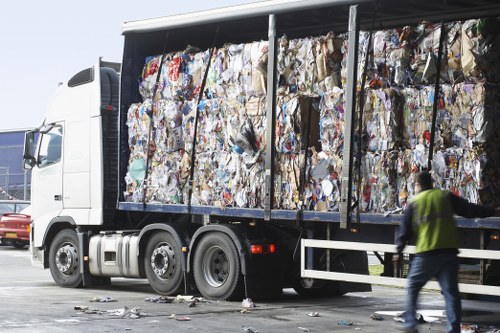 Vehicles, Transport and Site Access: Vehicle safety is critical for a rubbish and house clearance firm. Drivers must hold appropriate licences and undergo vehicle checks before each shift. Load security, weight limits and correct use of ramps and tail lifts are mandatory to prevent incidents during transit. When accessing private properties or communal areas, operatives must obtain consent where required, keep access points clear and safeguard members of the public with signage, barriers and supervision.
Training, Competence and Supervision: The company ensures staff competence through induction programmes, practical training in manual handling, hazardous waste awareness and vehicle operations. Regular refresher training and toolbox talks are used to reinforce safe working practices. Supervisors monitor performance and conduct spot checks to confirm adherence to the policy.
Incident Reporting, First Aid and Emergency Response: Any accident, near miss or property damage must be reported immediately and recorded. Adequate first aid provision and trained first aiders are maintained on-site or within close proximity to operations. Emergency procedures cover fire, chemical spills, exposure to hazardous substances and injury. An investigation process identifies root causes and corrective actions to prevent recurrence across future house clearance tasks.
Monitoring, Audit and Continuous Improvement: The organisation conducts regular audits and workplace inspections to measure compliance with the health and safety policy. Performance indicators, such as incident rates, training completion and audit findings, inform continuous improvement plans. Senior managers review the policy annually or sooner if there are significant changes to operations, legislation or lessons learned from incidents.
Record Keeping and Legal Compliance: The company retains accurate records of risk assessments, training, vehicle checks, waste transfer documentation and incident reports. These records support legal obligations and provide evidence of due diligence for regulatory inspections. By following this policy, the household clearance provider reduces risk, protects its workforce and the public, and promotes a culture of safety and professionalism across all rubbish removal and house clearance activities.
This Health and Safety policy is a living document and applies to all house clearance activities and waste management carried out by the company in the service area. It should be read in conjunction with statutory guidance and updated in line with operational or legal changes.